
Why Do Some Businesses Scale Effortlessly?
EverInvesting Scorecard Masterclass #5

Hi there, 👋
Welcome to part 5 of the EverInvesting Scorecard Masterclass.
In this series, I will go through my Scorecard and explain one new criterion every week.
Today’s criterion: Operating Leverage
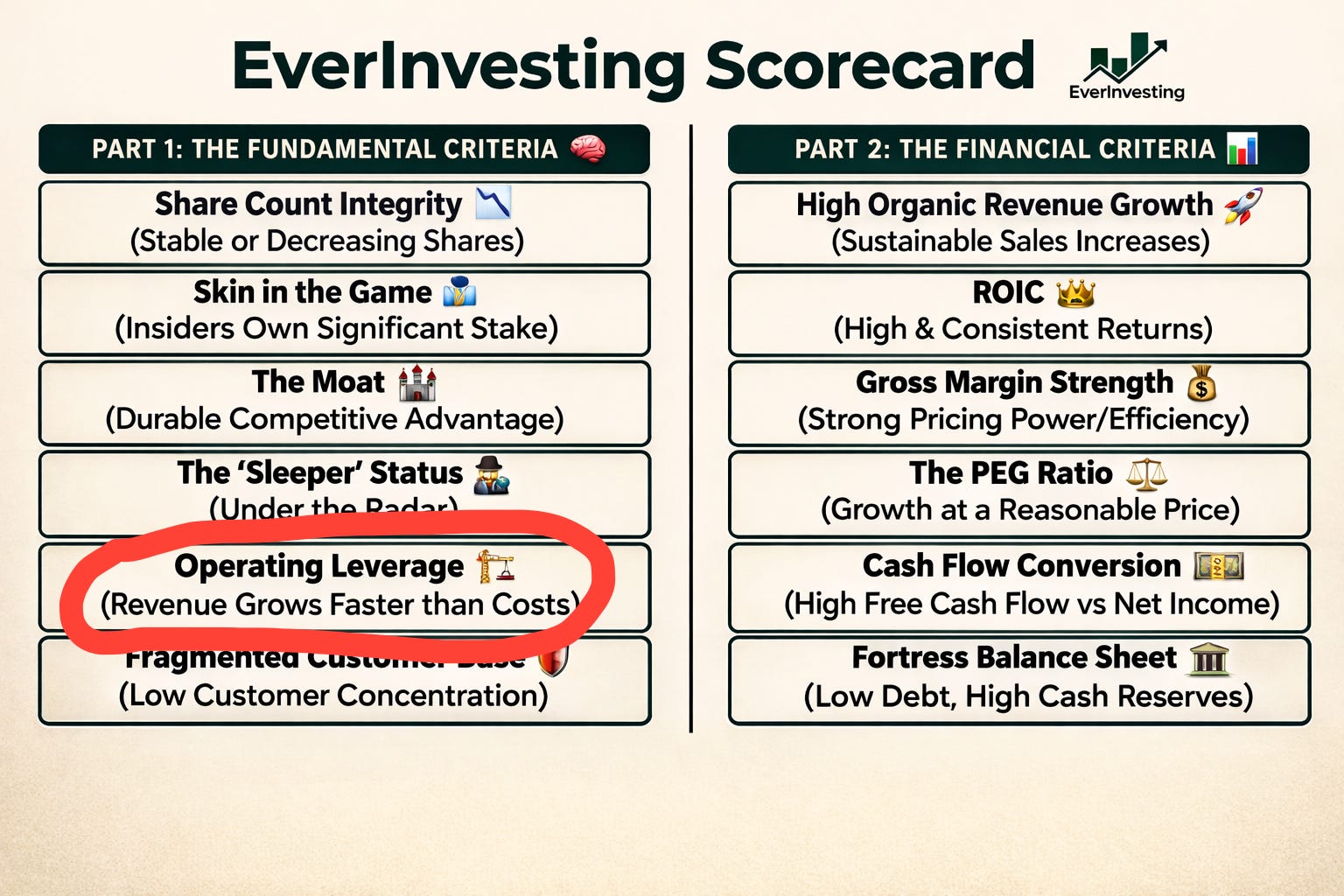
Marginal Cost Analysis
We are not just looking for growth; we are looking for Profitable Growth. Operating Leverage measures the elasticity of profit relative to revenue. It answers: How much does it cost to sell one more unit?
Low Operating Leverage (The Service Trap): Think of a law firm. To bill more hours, they must hire more lawyers. Revenue grows, but costs grow at the same speed. Margins remain flat. The business is linear.
High Operating Leverage (The Scalability Heaven): Think of a software company or an IP licensor. Once the software is coded, the cost to sell a copy to the 1,000th customer is near zero. Revenue grows, but costs stay flat. Margins expand exponentially.
The “J-Curve” Effect
We look for the inflection point. In the early days, a high-leverage business looks unprofitable because fixed costs (R&D, Platform build) are high. But once Revenue covers those fixed costs, every additional dollar drops straight to the bottom line. This creates a “J-Curve” in profitability. We want to buy right as the J-Curve turns upward.
The Check ✅
Look at the Income Statement trends over the last 3 years. Compare the growth rate of Revenue vs. the growth rate of SG&A (Selling, General & Administrative) and R&D expenses. We want to see: Revenue Growth > Expense Growth.
And now, we have arrived at the part where I give an example of a winner and loser for this criterion.
Example of a Winner: Fair Isaac Corporation
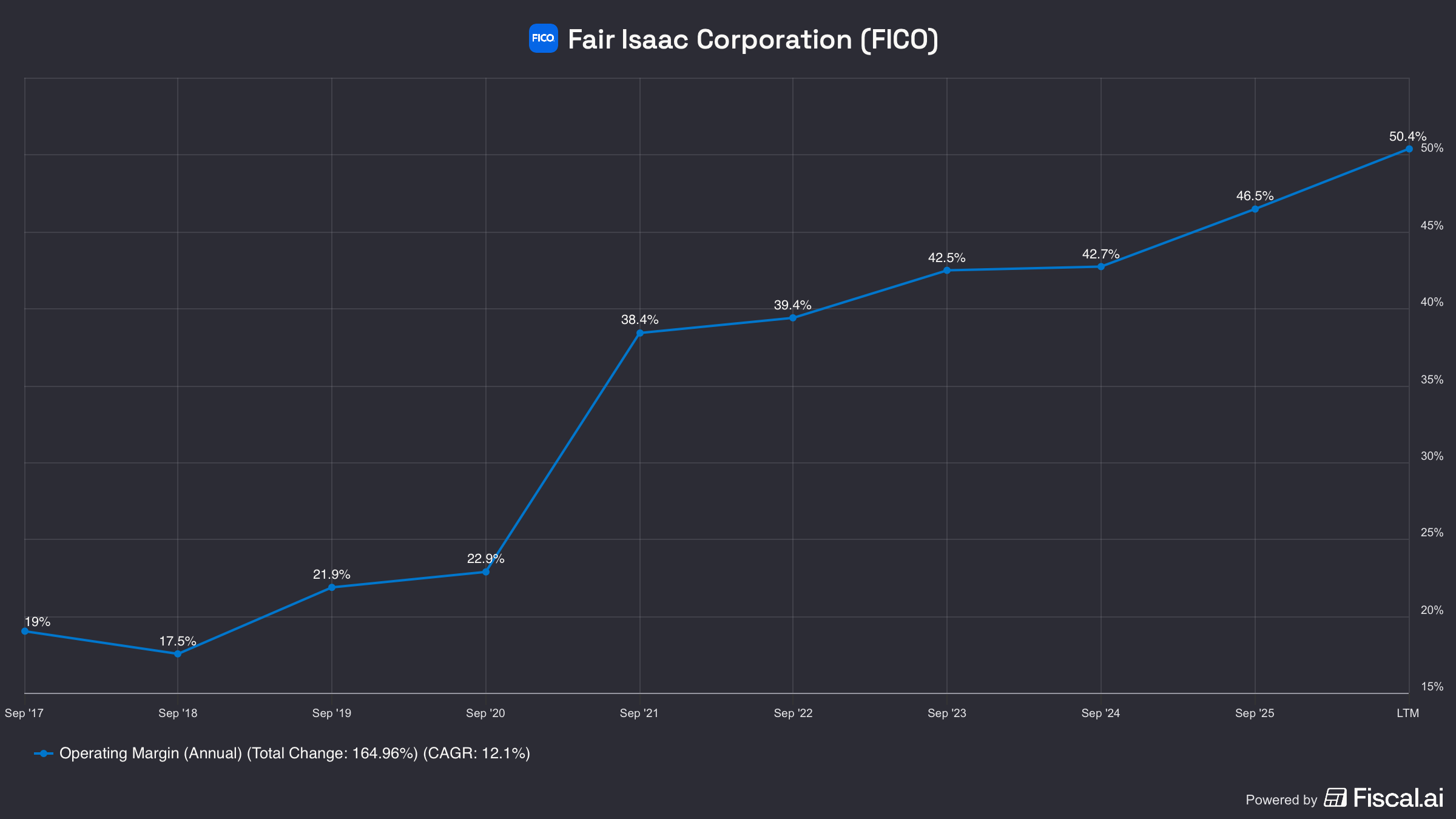
FICO is the undisputed king of the J-Curve. They own the FICO credit score, a three-digit number that dictates 90% of all lending decisions in the United States. If a bank wants to issue a mortgage, an auto loan, or a credit card, they have to ping FICO’s servers to check the applicant’s score. FICO charges a fee for this.
What is the marginal cost for FICO to generate and send that three-digit number over the internet? Literally zero. The heavy lifting (building the algorithm and securing the monopoly) was done decades ago. Today, whether they process one million credit checks or one billion, their fixed costs barely move. Every single time a bank requests a new FICO score, that revenue drops 100% straight to the bottom line. That is why their operating margins are structurally expanding past 40%. This is Scalability Heaven.
Example of a Loser: Delta Air Lines
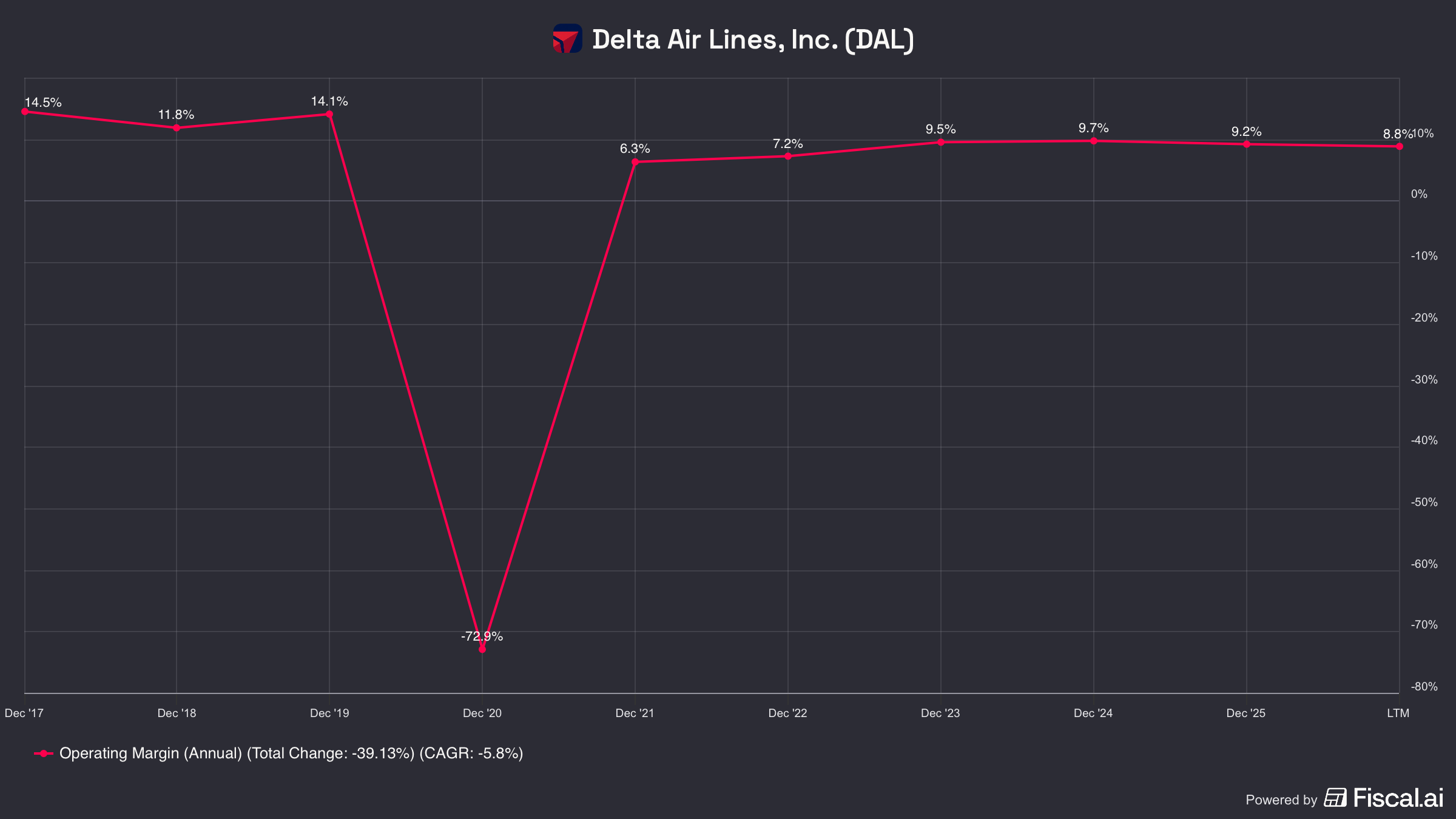
Airlines represent the exact opposite of compounding. They are the ultimate linear trap.
Think about the actual logistics for a second. If an airline decides to squeeze out more revenue by sending an extra 200 people to Paris tomorrow, they can’t just push a software update. They physically have to go out and buy a $150 million plane. Then they need to hire a specialized crew, burn through thousands of gallons of jet fuel, and pay extortionate fees just to land the thing.
Their costs rise at the exact same pace as their sales. You will never find a J-Curve in this industry. It honestly doesn’t matter how huge the company gets; the profit margins will always stay miserably thin. Why? Because you literally cannot generate a single new dollar of revenue without setting fire to a massive pile of fresh capital first.
That is it for today. Thank you for reading my work.
Next Monday I will tackle criterion #6: Fragmented Customer Base
If you want to stop guessing and see exactly which rare compounders actually survive the Scorecard and make it into my portfolio, join the Inner Circle below.
Until next time 👋,
Jules | EverInvesting
Disclaimer: Not financial advice. I am not a licensed financial advisor. This newsletter is for educational purposes only. The author may hold positions in the securities discussed. All investments carry significant risk, including the potential loss of principal. Always do your own research (DYOR). [Click here to read the full legal disclaimer].